Wong-Wang SDE Full Model, Cupy

[1]:
import os
import vbi
import torch
import warnings
import numpy as np
import pandas as pd
from cmaes import CMA
import networkx as nx
import sbi.utils as utils
from copy import deepcopy
from vbi.utils import timer
import multiprocessing as mp
import matplotlib.pyplot as plt
from vbi.inference import Inference
from vbi.models.cupy.ww import WW_sde
from vbi.feature_extraction.features_utils import get_fcd
from vbi import (
    extract_features,
    get_features_by_domain,
    get_features_by_given_names,
    update_cfg,
)

warnings.simplefilter("ignore")
[2]:
seed = 42
np.random.seed(seed)
torch.manual_seed(seed);

LABESSIZE = 10
plt.rcParams["axes.labelsize"] = LABESSIZE
plt.rcParams["xtick.labelsize"] = LABESSIZE
plt.rcParams["ytick.labelsize"] = LABESSIZE
[3]:
path = "output"
os.makedirs("output/ww_full", exist_ok=True)
[4]:
def wrapper(par):
    ''' Wrapper function to run the WW_sde model with given parameters.'''
    par = deepcopy(par)
    sde = WW_sde(par)
    data = sde.run()
    S_t = data["t"]
    S_d = data["S"]
    bold_d = data["bold_d"]
    bold_t = data["bold_t"]
    if par["RECORD_S"]:
        return S_t, S_d, bold_t, bold_d
    else:
        return bold_t, bold_d
[5]:
# --- define feature extraction configuration ---

cfg = get_features_by_domain("connectivity")
cfg = get_features_by_given_names(cfg, ["fcd_stat"])
cfg = update_cfg(cfg, "fcd_stat", parameters={"k": None, "win_len": 30, "TR": 0.5})
# report_cfg(cfg)
[6]:
# --- load connectivity matrix ---

D = vbi.LoadSample(nn=88)
weights = D.get_weights()
nn = weights.shape[0]
print(f"number of nodes: {nn}")
number of nodes: 88
[31]:
# --- Simulation Parameters ---

params = {
    "weights": weights,
    "engine": "cpu", # "gpu"
    "RECORD_S": False,
    "G_exc": 1.166,
    "ext_current": 0.09,
    "num_sim": 1,
    "sigma": 0.05,
    "t_cut": 0.5 * 60 * 1000.0,
    "t_end": 3 * 60 * 1000.0,
    "s_decimate": 10,
    "dt": 2.5,
    "tr": 300.0,
    "seed": seed,
    "dtype": "float32",
}

bold_t, bold_d = wrapper(params)
bold_d = np.transpose(bold_d, (2, 1, 0))

df = extract_features(
    bold_d, 1, cfg, n_workers=10, output_type="dataframe", verbose=False
)
print(df[["fcd_full_ut_std"]].values[0])
Integrating: 100%|██████████| 72000/72000 [00:22<00:00, 3167.04it/s]
[0.13350955]
[37]:
theta_true = [params["G_exc"], params["ext_current"]]
np.savez("output/ww_full/observation.npz", bold_t=bold_t, bold_d=bold_d, theta=theta_true)
df.to_csv("output/ww_full/observation.csv", index=False)
[8]:
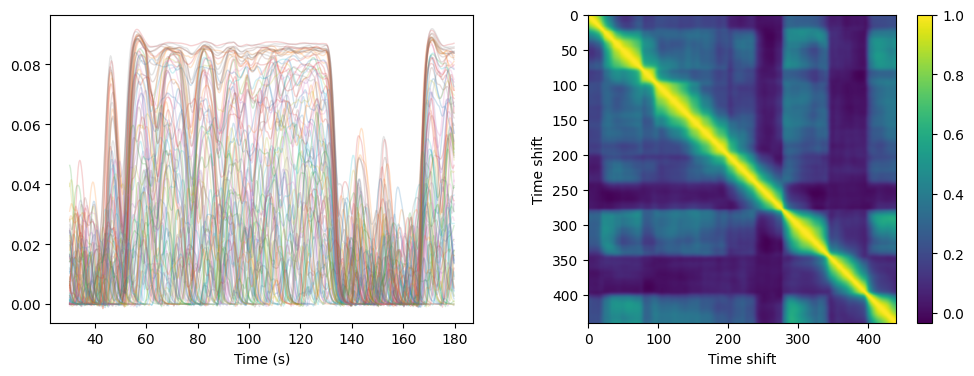
fcd = get_fcd(bold_d[0], win_len=30, TR=0.5)["full"]

plt.figure(figsize=(12, 4))
ax1 = plt.subplot(121)
ax1.plot(bold_t/1000, bold_d[0, ...].T, lw=1, alpha=0.2)
ax1.set_xlabel('Time (s)')
ax2 = plt.subplot(122)
im = ax2.imshow(fcd, cmap="viridis", aspect="equal")
plt.colorbar(im, ax=ax2)
plt.xlabel('Time shift')
plt.ylabel('Time shift')
plt.show()
To estimate G_exc and ext_current:
Set appropriate prior intervals.
Generate simulated training data.
Extract relevant features.
Train neural network to build posterior.
Sample from posterior distribution.
Visualize posterior distributions.
[21]:
num_sim = 2*1024
gmin, gmax = 0., 2.0
imin, imax = 0.0, 1.0
prior_min = [gmin, imin]
prior_max = [gmax, imax]
prior = utils.torchutils.BoxUniform(
    low=torch.as_tensor(prior_min), high=torch.as_tensor(prior_max)
)

obj = Inference()
theta = obj.sample_prior(prior, num_sim, seed=seed)
torch.save(theta, os.path.join(path, "theta.pt"))
[22]:
ext_current = theta[:, 1].numpy().squeeze()
G_exc = theta[:, 0].numpy().squeeze()

params = {
    "weights": weights,
    "engine": "gpu", # "gpu"
    "RECORD_S": False,
    "G_exc": 1.166,
    "ext_current": ext_current,
    "num_sim": num_sim,
    "sigma": 0.05,
    "t_cut": 0.5 * 60 * 1000.0,
    "t_end": 3 * 60 * 1000.0,
    "s_decimate": 10,
    "dt": 2.5,
    "tr": 300.0,
    "seed": seed,
    "dtype": "float32",
}

params["G_exc"] = G_exc
params["ext_current"] = ext_current

bold_t, bold_d = wrapper(params)
bold_d = np.transpose(bold_d, (2, 1, 0))
print(bold_d.shape, bold_t.shape)

df = extract_features(
    bold_d, 1, cfg, n_workers=10, output_type="dataframe", verbose=True
)
Integrating: 0%| | 0/72000 [00:00<?, ?it/s]Integrating: 100%|██████████| 72000/72000 [07:10<00:00, 167.36it/s]
(2048, 88, 499) (499,)
[24]:
np.savez("output/ww_full/ww_sde_data.npz", bold_t=bold_t, bold_d=bold_d, theta=theta.numpy())
df.to_pickle("output/ww_full/ww_sde_features.pickle")
[ ]:
# drop columns with low variance, keep retained column indices
remained_columns = df.std() > 0.01
df = df.loc[:, remained_columns]
x = df.values
x = torch.tensor(x, dtype=torch.float32)
torch.save(x, "output/ww_full/ww_sde_features.pt")
torch.save(prior, "output/ww_full/prior.pt")
[ ]:
remained_columns.to_csv("output/ww_full/remained_columns.csv", index=False)
[26]:
x.shape, theta.shape
[26]:
(torch.Size([2048, 18]), torch.Size([2048, 2]))
[30]:
obj = Inference()
posterior = obj.train(theta, x, prior, num_threads=8)
torch.save(posterior, "output/ww_full/posterior.pt")
WARNING:root:Found 48 NaN simulations and 0 Inf simulations. They will be excluded from training.
Neural network successfully converged after 105 epochs.train Done in 0 hours 0 minutes 26.325086 seconds
[ ]:
df_obs = pd.read_csv("output/ww_full/observation.csv")
df_obs = df_obs.loc[:, remained_columns]
x_obs = torch.tensor(df_obs.values.squeeze(), dtype=torch.float32)
[36]:
samples = obj.sample_posterior(x_obs, 10000, posterior)
[40]:
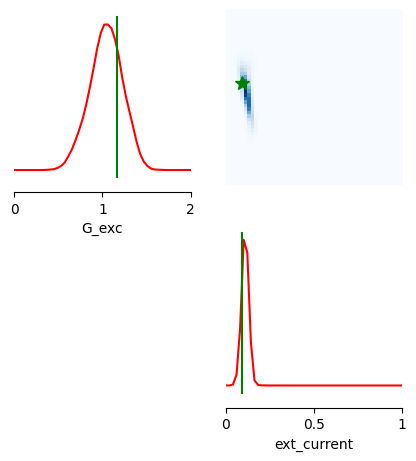
from sbi.analysis import pairplot

limits = [[i, j] for i, j in zip(prior_min, prior_max)]
fig, ax = pairplot(
    samples,
    limits=limits,
    figsize=(5, 5),
    points=[theta_true],
    labels=["G_exc", "ext_current"],
    offdiag='kde',
    diag='kde',
    fig_kwargs=dict(
        points_offdiag=dict(marker="*", markersize=10),
        points_colors=["g"]),
    diag_kwargs={"mpl_kwargs": {"color": "r"}},
    upper_kwargs={"mpl_kwargs": {"cmap": "Blues"}},
)