Virtual Epileptic Patient

[1]:
import os
import tqdm
import torch
import pickle
import numpy as np
import networkx as nx
import sbi.utils as utils
from vbi import report_cfg
import matplotlib.pyplot as plt
from vbi.utils import LoadSample
from sbi.analysis import pairplot
from vbi.models.cpp.vep import VEP
from vbi.inference import Inference
from sklearn.preprocessing import StandardScaler
[4]:
seed = 2
np.random.seed(seed)
torch.manual_seed(seed);
[5]:
os.makedirs("output/vep", exist_ok=True)
[6]:
weights = np.loadtxt("data/weights1.txt")
nn = weights.shape[0]
healthy zone, propagation zone, epileptic zone eta values
[7]:
hz_val = -3.65
pz_val = -2.4
ez_val = -1.6
[8]:
ez_idx = np.array([6, 34], dtype=np.int32)
pz_wplng_idx = np.array([5, 11], dtype=np.int32)
pz_kplng_idx = np.array([27], dtype=np.int32)
pz_idx = np.append(pz_kplng_idx, pz_wplng_idx)
[9]:
eta_true = np.ones(nn) * hz_val
eta_true[pz_idx] = pz_val
eta_true[ez_idx] = ez_val
[11]:
initial_state = np.zeros(2 * nn)
initial_state[:nn] = -2.5
initial_state[nn:] = 3.5
# --------------------------------------------------------------------------- #
[12]:
params = {
    "G": 1.0,
    "seed": seed,
    "initial_state": initial_state,
    "weights": weights,
    "tau": 10.0,
    "eta": -3.5,
    "noise_sigma": 0.0,
    "iext": 3.1,
    "dt": 0.1,
    "tend": 14.0,
    "tcut": 1.0,
    "noise_seed": 0,
    "record_step": 1,
    "method": "heun",
    "output": "output",
}
[13]:
obj = VEP(params)
g_true = 1.0
eta_true = [-1.6] * 2
eta_true_ = np.ones(nn) * hz_val
eta_true_[pz_idx] = pz_val
eta_true_[ez_idx] = ez_val
control_true = {"eta": eta_true_, "G": g_true}
[14]:
data = obj.run(par=control_true)
[15]:
ts = data["x"]
t = data["t"]
[20]:
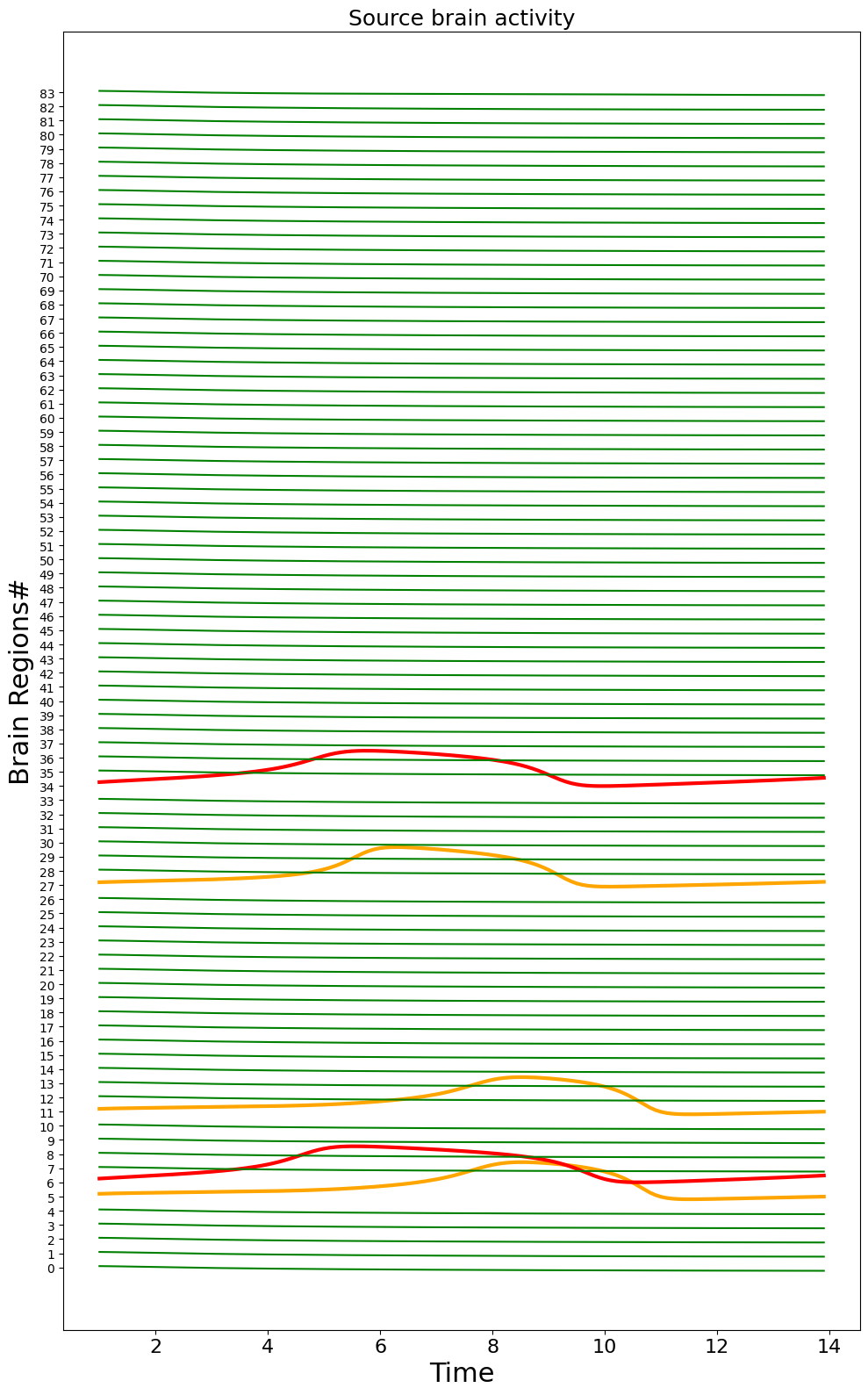
plt.figure(figsize=(10, 16))
for i in range(0, nn):
    if i in ez_idx:
        plt.plot(t, ts[i, :] + i, "r", lw=3)
    elif i in pz_idx:
        plt.plot(t, ts[i, :] + i, "orange", lw=3)
    else:
        plt.plot(t, ts[i, :] + i, "g")
plt.yticks(np.r_[0:nn] - 2, np.r_[0:nn], fontsize=10)
plt.xticks(fontsize=16)
plt.title("Source brain activity", fontsize=18)
plt.xlabel("Time", fontsize=22)
plt.ylabel("Brain Regions#", fontsize=22)
plt.tight_layout()
# plt.savefig("output/vep_sde.png", dpi=300)
[21]:
from vbi.feature_extraction.features_settings import *
from vbi.feature_extraction.calc_features import *
[22]:
fs = 1 / (params["dt"]) / 1000
cfg = get_features_by_domain(domain="statistical")
# cfg = get_features_by_given_names(cfg, names=["calc_moments"])
cfg = get_features_by_given_names(cfg, names=["auc"])
# report_cfg(cfg)
[23]:
data = extract_features_df([ts], fs, cfg=cfg, n_workers=1)
print(data.values.shape)
100%|██████████| 1/1 [00:00<00:00, 1381.52it/s]
(1, 84)
[24]:
def wrapper(params, control, x0, cfg, verbose=False):
    vep_obj = VEP(params)
    sol = vep_obj.run(control, x0=x0)

    # extract features
    fs = 1.0 / params["dt"] * 1000  # [Hz]
    stat_vec = extract_features(
        ts=[sol["x"]], cfg=cfg, fs=fs, n_workers=1, verbose=verbose
    ).values[0]
    return stat_vec
[25]:
def batch_run(params, control_list, x0, cfg, n_workers=1):
    n = len(control_list)
    def update_bar(_):
        pbar.update()
    with Pool(processes=n_workers) as pool:
        with tqdm.tqdm(total=n) as pbar:
            async_results = [
                pool.apply_async(
                    wrapper,
                    args=(params, control_list[i], x0, cfg, False),
                    callback=update_bar,
                )
                for i in range(n)
            ]
            stat_vec = [res.get() for res in async_results]
    return stat_vec
[29]:
num_sim = 1000
num_workers = 10
eta_min, eta_max = -5.0, -1.0
gmin, gmax = 0.0, 2.0
[30]:
prior_min = [gmin] + [eta_min] * 2
prior_max = [gmax] + [eta_max] * 2
[31]:
prior = utils.BoxUniform(low=torch.tensor(prior_min), high=torch.tensor(prior_max))
[32]:
obj = Inference()
theta = obj.sample_prior(prior, num_sim)
theta_np = theta.numpy().astype(float)
[33]:
print(theta_np.shape)
(1000, 3)
[34]:
control_list = []
for i in range(num_sim):
    eta_ = np.ones(nn) * hz_val
    eta_[pz_idx] = pz_val
    eta_[ez_idx] = theta_np[i, 1:]
    g_ = theta_np[i, 0]
    control_list.append({"eta": eta_, "G": g_})
[35]:
stat_vec = batch_run(params, control_list, initial_state, cfg, num_workers)
100%|██████████| 1000/1000 [00:01<00:00, 885.54it/s]
[36]:
scalar = StandardScaler()
stat_vec_st = scalar.fit_transform(np.array(stat_vec))
stat_vec_st = torch.tensor(stat_vec_st, dtype=torch.float32)
torch.save(theta, "output/vep/theta.pt")
torch.save(stat_vec, "output/vep/stat_vec.pt")
[37]:
print(theta.shape, stat_vec_st.shape)
torch.Size([1000, 3]) torch.Size([1000, 84])
[38]:
posterior = obj.train(
    theta, stat_vec_st, prior, method="SNPE", density_estimator="maf", num_threads=8
)
Neural network successfully converged after 272 epochs.train Done in 0 hours 1 minutes 18.045039 seconds
[39]:
with open("output/vep/posterior.pkl", "wb") as f:
    pickle.dump(posterior, f)
[40]:
with open("output/vep/posterior.pkl", "rb") as f:
    posterior = pickle.load(f)
/home/ziaee/anaconda3/envs/vbi_paper/lib/python3.11/site-packages/torch/storage.py:414: FutureWarning: You are using `torch.load` with `weights_only=False` (the current default value), which uses the default pickle module implicitly. It is possible to construct malicious pickle data which will execute arbitrary code during unpickling (See https://github.com/pytorch/pytorch/blob/main/SECURITY.md#untrusted-models for more details). In a future release, the default value for `weights_only` will be flipped to `True`. This limits the functions that could be executed during unpickling. Arbitrary objects will no longer be allowed to be loaded via this mode unless they are explicitly allowlisted by the user via `torch.serialization.add_safe_globals`. We recommend you start setting `weights_only=True` for any use case where you don't have full control of the loaded file. Please open an issue on GitHub for any issues related to this experimental feature.
  return torch.load(io.BytesIO(b))
[41]:
xo = wrapper(params, control_true, initial_state, cfg)
xo_st = scalar.transform(xo.reshape(1, -1))
[42]:
samples = obj.sample_posterior(xo_st, 10000, posterior)
# torch.save(samples, "output/vep/samples.pt")
[43]:
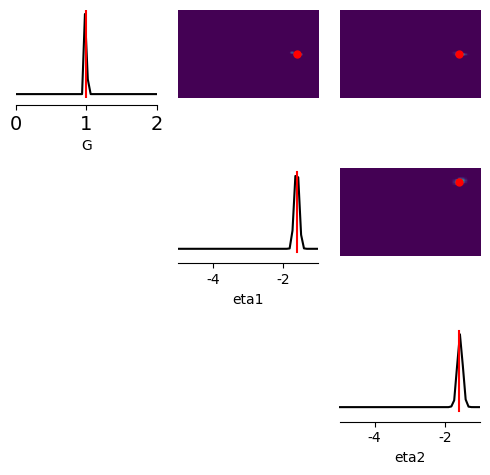
limits = [[i, j] for i, j in zip(prior_min, prior_max)]
points = [[g_true] + eta_true]
fig, ax = pairplot(
    samples,
    limits=limits,
    figsize=(5, 5),
    points=points,
    labels=["G", "eta1", "eta2"],
    offdiag="kde",
    diag="kde",
    points_colors="r",
    samples_colors="k",
    points_offdiag={"markersize": 10},
)
ax[0, 0].tick_params(labelsize=14)
ax[0, 0].margins(y=0)
plt.tight_layout();
[ ]: